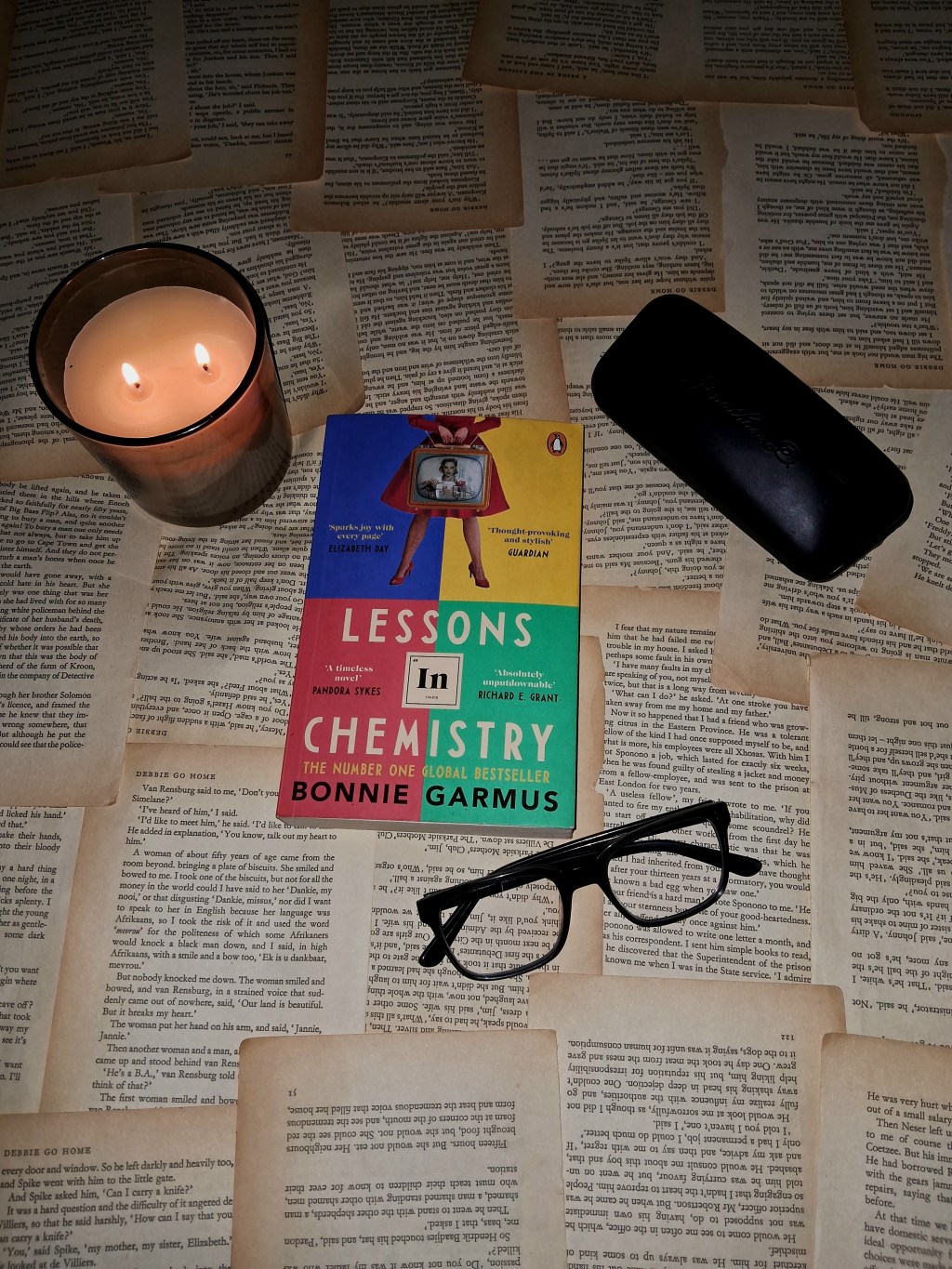
Women don’t understand chemistry
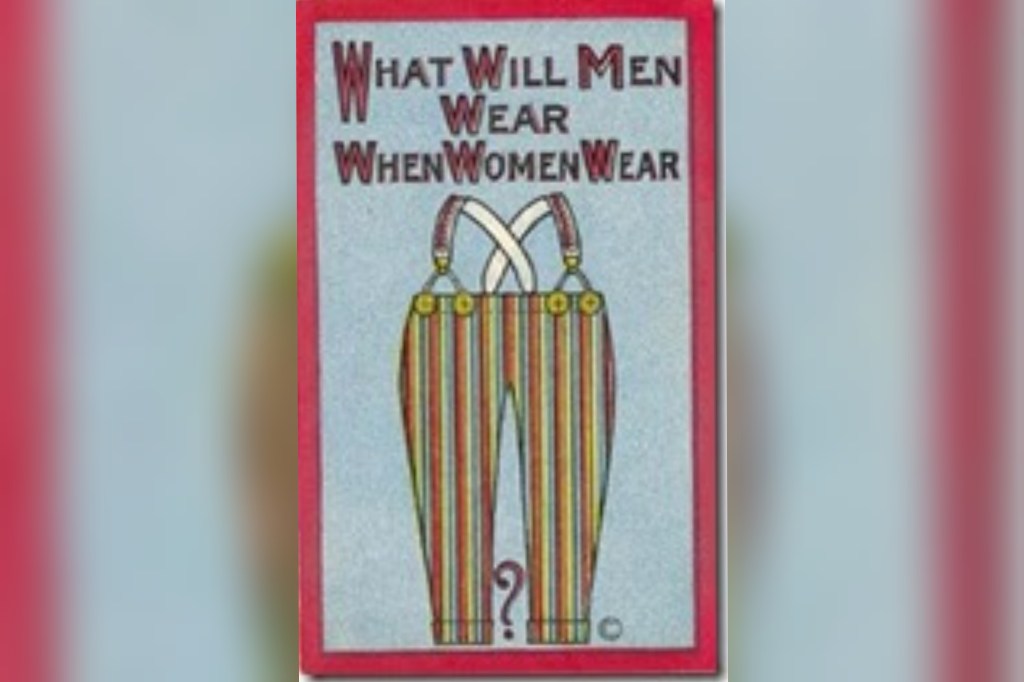
When you pick a female television host, first make sure she’s beautiful. Not pretty. That’s hollow girl-talk that barely means anything. She must be beautiful. Hot, even. Nothing less. Next, make sure she’s well suited for the male gaze. She should smile and wear frilly dresses so tight they threaten to burst at the seams. But god forbid she wears trousers! If huns wear trousers, what will the men wear? Exactly. Next, make her say simple, vapid statements that appeal to her fellow simple-minded women. You can’t have her teach chemistry on daytime television! Women don’t understand that. And last, make sure the host’s name isn’t Elizabeth Zott. That will save you a headache. Or a heart attack.
“Elizabeth Zott held grudges too. Except her grudges were mainly reserved for a patriarchal society founded on the idea that women were less. Less capable. Less intelligent. Less inventive. A society that believed men went to work and did important things—discovered planets, developed products, created laws—and women stayed at home and raised children.”
― Bonnie Garmus, Lessons in Chemistry
Summary
Chemist Elizabeth Zott is not your average woman. In fact, Elizabeth Zott would be the first to point out that there is no such thing as an average woman. But it’s the early 1960s and her all-male team at Hastings Research Institute takes a very unscientific view of equality. Except for one: Calvin Evans; the lonely, brilliant, Nobel–prize nominated grudge-holder who falls in love with—of all things—her mind. True chemistry results.
But like science, life is unpredictable. Which is why a few years later Elizabeth Zott finds herself not only a single mother, but the reluctant star of America’s most beloved cooking show Supper at Six. Elizabeth’s unusual approach to cooking (“combine one tablespoon acetic acid with a pinch of sodium chloride”) proves revolutionary. But as her following grows, not everyone is happy. Because as it turns out, Elizabeth Zott isn’t just teaching women to cook. She’s daring them to change the status quo.
It’s not your imagination. The world still is pretty awful.
We like to assume that the human race is constantly evolving, that we can not possibly err in the same way our ancestors did–because progress is as linear as it is constant. It is comforting to assume that because more women have attained financial independence, the world is now just as safe, or just as ideal for women, as it is for men.
As I read Lessons in Chemistry, I kept forgetting that the novel is set in the 1960s, because while technology and fashion have evolved, it seems that the regressive ideas that inform societal norms have not. Choosing to disbelieve female victims of sexual assault? People do that in 2024. Men feeling entitled to sexual favours from women? Ditto. People discounting the achievements of women on the basis of their gender? Is this f*cking play about us???
Seeing Miss Zott being called “Luscious Lizzie” at her workplace and having her male peers take credit for her work feels too similar to observing Kamala Harris being reduced to a ‘DEI hire’ who ‘slept her way to the top’ in her 2024 run for President of the United States. It cruelly reflects the way some people wholeheartedly believe women can not be leaders, or that they are innately irrational. What this boils down to is one problem: women are not taken seriously enough. If they were, the possibility of having a female president in one of the world’s leading countries wouldn’t prompt AI generated pictures meant to sexualise and degrade her. If they were, we would have fewer twitter threads, disparaging rape victims and coddling abusers. If women were really taken seriously–by men and by other women–then perhaps we would consider women’s purpose as something beyond childbirth.
“Imagine if all men took women seriously. Education would change. The workforce would revolutionize. Marriage counsellors would go out of business. Do you see my point?”
― Bonnie Garmus, Lessons in Chemistry
The fact that this is a historical fiction novel is mind-blowing. Drawing parallels between the adverse treatment of women in the 1960s and the treatment of women now, should be wholly unthinkable. But it’s not. What this reflects, is that we are prone to making the same errors our ancestors did, and that freedom is a constant struggle. The author expertly calls out the arbitrary notions that limit people to their gender.
“as humans, we’re by-products of our upbringings, victims of our lackluster educational systems, and choosers of our behaviors. In short, the reduction of women to something less than men, and the elevation of men to something more than women, is not biological: it’s cultural. And it starts with two words: pink and blue. Everything skyrockets out of control from there.
-Bonnie Garmus, Lessons in Chemistry
The novel therefore critiques the way gender roles limit individuals on the basis of their gender. Many advocates for ‘traditional’ gender roles argue that they are the basis of society, which is just a weak attempt at legitimising misogyny. For cultural notions to be taken seriously, they have to be legitimate and they must be necessary. In answering the question as to whether women’s evolutionary biology prescribes for them to “belong in the kitchen”, Chimamanda Ngozi Adichie states,
“The knowledge of cooking does not come pre-installed in a vagina. Cooking is learned… If we stopped conditioning women to see marriage as a prize, then we would have fewer debates about a wife needing to cook in order to earn that prize.”
– Chimamanda Ngozi Adichie, Dear Ijeawele, or A Feminist Manifesto in Fifteen Suggestions
Ultimately, the classification of learned behaviours and duties on the basis of one’s gender has no basis in fact. It should never be taken as a radical notion, that capable women should get just as many opportunities, as capable men do.

But… I never thought they’d eat my face!
The manner in which women internalise misogyny and become partakers in a system meant to harm them, is ultimately reflected through Fran Frask, a personnel officer whose gossip about Elizabeth’s pregnancy out of wedlock resulted in Elizabeth being fired from her job. This was a classic case of the Pearl Davies syndrome, “If I’m a good, loyal good-girl to these powerful man-men… even at the expense of other women, then that means I’m better than all these irrational women! *heart eyes* #notlikeothergirls”. The irony of the fact that Fran went on to be fired for her weight, rather than her performance at work, reflects that the patriarchy does not protect those who pander to it. In its eyes, women are just that, women. In the same way a woman can be fired for getting pregnant without a husband, so can another for being heavier than the patriarchy deems desirable.

When Frask finally came to terms with the fact that the only reason she did not further her studies was that she had been sexually assaulted at her university, and therefore felt unsafe learning there, the only person who listened, with no judgement, and could relate to her situation, was another woman–the same woman she had previously gotten fired. This reflects the need for community in any marginalised group. When far-right political actors begin to strip queer people of their rights, they won’t consider that certain queer people were better bootlickers than others. Yes, even the ‘LGB without the TQ+’ gang, even the ‘normal gays’ will be targeted. The only people who will be present to support them then, to affirm their identity and to listen, without judgement, are the very freaks they distance themselves from, the very people they demonise.
Hold my bible
Religion, in the text, is viewed as a form of escapism, as something we partake in to escape the harsh realities of the real world. A god is viewed as something we create in our heads and believe in, in order to absolve ourselves of the responsibility to do better and to create a better world for ourselves and others. The idea of heaven gives us something to look forward to, and makes us slacken, because when we think that life on Earth is not so important, then maybe it’s not so bad that some people suffer on earth more than others do. In some parts, Zott calls out religion for being a scapegoat used by oppressors to escape liability for their actions.
“I think it (religion) lets us off the hook. I think it teaches us that nothing is really our fault; that something or someone else is pulling the strings; that ultimately, we’re not to blame for the way things are; that to improve things, we should pray. But the truth is, we are very much responsible for the badness in the world. And we have the power to fix it.”
– Bonnie Garmus, Lessons in Chemistry
In other parts, Garmus explores how religion becomes a coping mechanism for when people fail to understand the complex nature of life and of the universe.
“One thing I’ve learned, Calvin: people will always yearn for a simple solution to their complicated problems. It’s a lot easier to have faith in something you can’t see, can’t touch, can’t explain, and can’t change, rather than to have faith in something you actually can.” She sighed. “One’s self, I mean.”
― Bonnie Garmus, Lessons in Chemistry
Through Zott, the reader is made privy to one of the frustrations that atheists have towards religious ideology: how it creates the willingness to prioritise a being whose existence you cannot prove, over the lives of other humans, whose lives, pain and suffering are very much real.

Elizabeth Zott goes about her life seeking facts, logic and reason, and this becomes a major reason why she is an atheist. Although it is true that her childhood was compromised by her father’s antics as a religious con artist, Zott does not often attribute her atheism to her personal upbringing, and when she does, it is often buried under layers of analysis, logic, and reason. It is not until her encounter with Avery Parker, that it is made clear to the reader, that nonbelief is not always to be a product of hours of scientific analysis. As Parker relates the story of how a Catholic orphanage lied to her about the death of her child, in order to compel her to set up a memorial fund for the orphanage, she explodes,
“YOU DON’T BELIEVE IN GOD FOR SCIENTIFIC REASONS, MISS ZOTT? … WELL, I DON’T BELIEVE IN GOD FOR PERSONAL REASONS.”
– Bonnie Garmus, Lessons in Chemistry
Okay… what about the writing?
The book was honestly really fun to read. The pacing was fast, the writing was crisp and some chapters carried a thriller-like suspense. For a book about how women are historically oppressed, the book was really funny and carried a lot of wit. I felt energised at the end–it even prompted me to make my first blog post in ages. I highly recommend this book!
“Whenever you feel afraid, just remember. Courage is the root of change – and change is what we’re chemically designed to do. So when you wake up tomorrow, make this pledge. No more holding yourself back. No more subscribing to others’ opinions of what you can and cannot achieve. And no more allowing anyone to pigeonhole you into useless categories of sex, race, economic status, and religion. Do not allow your talents to lie dormant, ladies. Design your own future. When you go home today, ask yourself what YOU will change. And then get started.”
― Bonnie Garmus, Lessons in Chemistry
 By Augustine
Leave a comment