
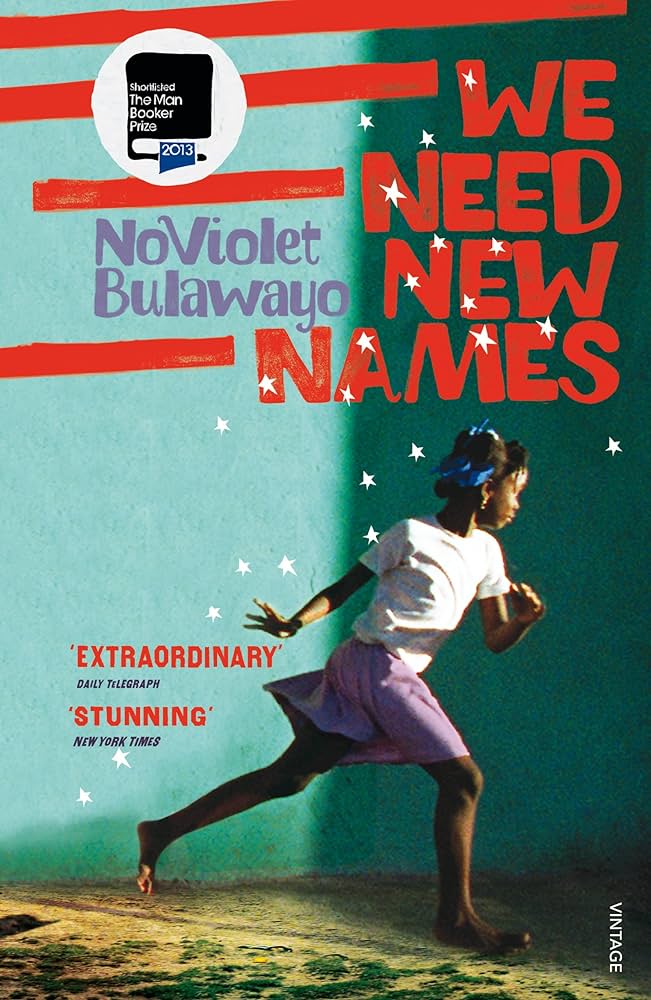
Identity is a central part of human existence and the degree to which it is essential cannot be overstated. So, does Noviolet Bulawayo succeed in communicating the issues that surround contemporary Zimbabwean identity, or is the novel simply an exhausting collection of clichéd issues in African literature? This article will examine the concerns raised in the text and evaluate the scathing review of the novel made by a journalist for The Guardian.
Check out quotes from the book on my Instagram:
If I had to nominate a single book as the funniest one I read in 2023, it would be “We Need New Names” by NoViolet Bulawayo. The wit, sass and characterisation were enough to keep me hollering for minutes on end. (Some characters are literally named Bastard, Sbho and Prophet Revelations Bitchington Mborro 💀). The absurdity of Darling’s childish thoughts is what really crowns the comedic element of the novel.
However, the book is not merely an African, Gringo-like take on comedy. It is a stunningly brave literary contribution that explores such issues as race, HIV/AIDS, political tyranny, identity and poverty.
This coming-of-age novel documents the life of Darling as she navigates childhood amid extreme poverty. The reader is taken through a series of silly, joyful and heartbreaking experiences, until Darling finally finds herself in America, where the illusion of a perfect and easy life slowly fades and she finds herself missing the very “kaka” place she had wanted to escape for so long.
MAJOR THEMES
Identity
We Need New Names calls upon individuals (Zimbabweans in particular) to change their names and reclaim their identity. Bulawayo uses humour to mirror the popularised notion of ‘African identity’—one that depicts Africans as being inherently poor, backward and plain stupid. This is depicted by such names as Bastard, Sbho and Stina, which do not seem to hold much positive meaning.
There is also a lot of self-doubt and internalised racism that plagues the characters of the novel. This is shown by how Darling was revered by her peers for being able to speak to white people on the phone, in English. This is reflected in Zimbabwean society today, by how most blacks seem to suck up to whites, often at the expense of other blacks—most black Zimbabweans can tell of a time when a white person was given first preference at a bank, store or at the airport by a fellow black person.
This idea held by black Zimbabweans that black people are inherently inferior is further highlighted by how Sbho believes that in order to properly perform an operation on Chipo, the crew needed to change their names to those of the white surgeons they had seen on television.
However, this inferiority complex is not only tied to Africa, but is showcased by how Darling felt she needed to ‘Americanise’ her accent in order to be taken seriously by white Americans. This complex is made worse by how white Americans intentionally misinterpret words coming from anyone with a foreign accent, as epitomised by Aunt Fostalina’s Victoria’s Secret phone call.
The idea that being black is tied to a specific, singular identity is debunked by the novel. While Kristal(African-American), Marina(Nigerian) and Darling(Zimbabwean) are all black, they do not share the same experiences and their differences make them laugh at each other on the drive to the mall, despite them all being perceived as mere blacks in America. Thus, the novel broadly explores the issue of identity.
Religion
There is a major clash in the novel between Indigenous beliefs and Christian ones. The people living in Paradise seem to distance themselves from traditional practitioners, as they go for cleansing on Fambeki hill whenever they visit Vodloza, the ‘traditionalist’. While Vodloza himself seems to be more of a phony, the same can be said about Prophet Revelations Bitchington Mborro, who sexually assaults a woman in the name of ‘delivering her from evil spirits’. The fact that many Africans today favour the religion of their former colonial masters is therefore addressed in the text.
Karl Marx has famously stated that religion is the opium of the masses, that distracts them from tyranny and poverty. While this is true for such characters as Mother and Mother of Bones, it is not true for Darling. Darling does not find an escape in religion, but instead seeks to hold God accountable for abandoning his people. This is especially shown when Darling muses that grandmother wastes her time praying on Fambeki, because “God will just ignore her”. This is further shown when prayers are being made for Darling’s father:
I think of praying for her (Darling’s mother, who is exhausted from working so hard) so that her tiredness goes away but then I remind myself I have decided that praying to God is a waste of time. You pray and pray and pray and nothing changes, like for example I prayed for a real house and good clothes and a bicycle and things for a long, long, time, and none of it has happened, not even one little thing, which is how I know that all this praying for Father is just people playing.
In fact, it is not until Darling goes to America and starts to enjoy life with privileges she could only dream of back in Paradise, that she restores her faith in God. Hence, religion is addressed in the text.
Exploitation
The black security guard in Budapest is an apt example of exploitation. This is made abundantly clear by how the children find it amusing that he works so hard to protect the whites, yet they see him as nothing.
The photograph in the raided house is also symbolic of oppression, “In the pictures we see women in long dresses and funny hats. A boy rides a black horse; he looks happy, the horse doesn’t.”. The white boy riding the black horse is symbolic for the ‘partnership’ idea that was peddled by white Rhodesians, under which they would be riders and the blacks would be horses. This ‘partnership’ however, would solely benefit the whites, as shown by the unhappy black horse.
Moreso, the Chinese construction site in the ‘Country Game’ chapter reeks of exploitation. Black people are reduced to starving labourers and sex workers by Chinese moguls. One of the Chinese men has grown unbelievably fat off of the backs of the labourers and is referred to as “Fat Mangena”. The fact that he thrives so much at the expense of the blacks and does not bother to learn the local language, choosing to ‘ching-chong’ orders to the black workers all day, reeks of exploitation.
Charlatans and phonies also make a killing by capitalising on people’s problems. This is especially revealed through Vodloza’s comic poster that reads,
VODLOZA, BESTEST HEALER IN ALL OF THIS PARADISE AND BEEYOND WILL PROPER FIX ALL THESE PROBLEMSOME THINGS THAT YOU MAY ENCOUNTER IN YOUR LIFE: BEWITCHEDNESS, CURSES, BAD LUCK, WHORING SPOUSES, CHILDRENLESSNESS, POVERTY, JOBLESSNESS, AIDS, MADNESS, SMALL PENISES, EPILEPSY, BAD DREAMS, BAD MARRIAGE/MARRIAGELESSNESS, COMPETITION AT WORK, DEAD PEOPLE TERRORIZING YOU, BAD LUCK WITH GETTING VISAS ESPECIALLY TO USA AND BRITAIN, NONSENSEFUL PEOPLE IN YOUR LIFE, THINGS DISAPPEARING IN YOUR HOUSE ETC. ETC. ETC. PLEASE PAYMENT IN FOREX ONLY.
Darling is also exploited by her boss in America, who seeks to overwork her as much as he can.
Hence, the novel addresses exploitation.
Tyranny
Bulawayo is no stranger to such issues as this, as her second novel, Glory also addresses cruel leadership.
In We Need New Names, this is highlighted by how government agents and police officers demolish people’s homes, forcing them to relocate to the squatter settlement, Paradise, which is ironically named, as it is far from paradise. This echoes similar happenings in Zimbabwe in 2005, dubbed ‘operation murambatsvina’, which disadvantaged thousands of civilians.
The theme is further addressed through the murder of Bornfree and the intimidation of people who stood with the opposition party. The fact that the ruling party had to murder a major advocate for the opposition spells out Orwellian leadership.
Friendship
Darling’s friendship with Bastard, Chipo, Godknows, Sbho and Stina was a heartwarming one. This crew navigated the harsh conditions of Paradise together and the strength of their friendship is ultimately portrayed by how, upon discovering that Darling’s father had AIDS, her friends comforted her and showed her that they would still play together, despite her father’s illness.
Friendship is shown as something that is important and relies on trust, which requires time to build. This is revealed by how Sbho was particularly hostile towards Forgiveness when she tried to help with Chipo’s abortion, because they did not know each other well enough yet.
However, it is not depicted as something that is invincible. Darling promises to remain in touch with her friends, only to later realise that she has forgotten about them while she is in America, where he has found new friends with whom to watch ‘flicks’ in the basement of Aunt Fostalina’s home.
In conclusion, We Need New Names is a remarkable read that tackles heavy themes using light-hearted, childish humour. Contrary to the review made by The Guardian, the book does not feel like reading an article written ‘with a checklist in mind’ but rather, is relatable for many Zimbabweans and explores the plight of American immigrants and Zimbabweans who feel trapped in a hostile environment.
This was certainly one of my favourite books of 2023 and I highly recommend it for lovers of African literature and lovers of literature in general.
Check out my Instagram, where I post live updates of the books I’m reading: https://instagram.com/its_august_ine?igshid=MzMyNGUyNmU2YQ==
 By Augustine
Leave a comment